
Ruminants
Simplify Complex Rations and Protect Margins with U.S. Soy
Dairy and beef producers operate on some of the tightest margins in animal agriculture, where every ration decision carries both cost and performance consequences. The complexity of ruminant digestion, in which feed must nourish the rumen microbes as well as the animal itself, can create formulation uncertainty that raises additive costs and leaves feed efficiency inconsistent.
Soybean meal derived from U.S. Soy helps simplify that complexity. It supplies a well-balanced complement of essential amino acids,1 digestible fiber, and, in full-fat form, energy-dense oil that together support rumen function and animal performance. 1 As a consistent, versatile base ingredient, it reduces the number of variables a nutritionist must manage and delivers nutrients reliably to both the rumen microbes and the animal.2
One Seed, Multiple Nutritional Tools
From a single processing stream, soybeans yield several functionally distinct feedstuffs. This gives nutritionists rare flexibility to match the ingredient to whichever nutrient is limiting in the ration. 1
- Soybean meal supplies concentrated, high-quality protein with a favorable amino acid profile well suited to forage-based diets. 1
- Full-fat soybeans pair protein with energy-dense oil, a combination valued for early-lactation dairy cows and growing cattle on forage. 1,3
- Soybean hulls provide highly digestible, low-starch fiber that supports rumen health while contributing usable energy.4
- Controlled heat treatment increases the rumen-undegradable (bypass) protein fraction, sending more protein to the small intestine for direct absorption.5
Digestive Health Drives Feed Efficiency
A stable, well-functioning rumen is the foundation of feed efficiency in dairy and beef cattle. The digestible fiber in soybean hulls is readily fermented by the rumen microbes into the volatile fatty acids that supply much of a ruminant’s energy,2 and it can replace a portion of rapidly fermented starch to help stabilize rumen pH.1 Supporting healthy rumen microbial function helps direct more nutrients toward production.
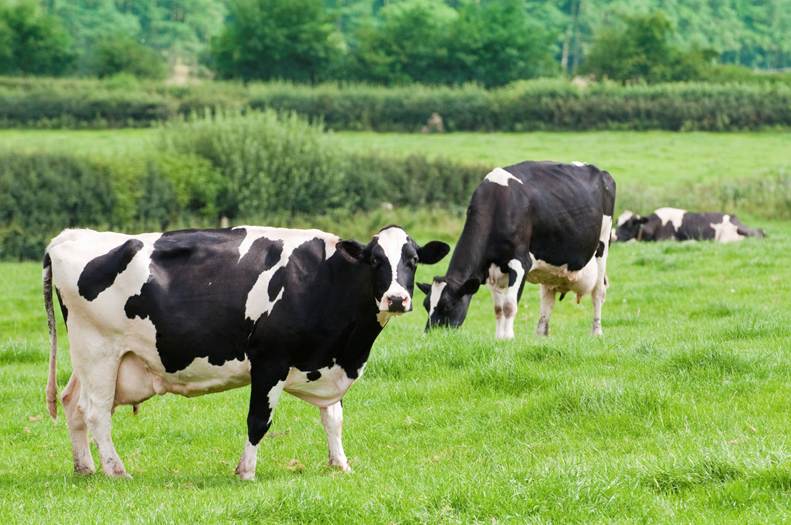
Dairy: Protein That Reaches the Cow
In high-producing dairy cows, the metabolizable protein delivered to the small intestine, made up of rumen-undegradable feed protein and microbial protein, closely influences milk protein yield.6
- Heat-treated soy products, such as roasted soybeans or expeller-pressed meal, raise the rumen-undegradable protein fraction to help meet that demand.7
- Soy supplies lysine and methionine, amino acids closely linked to milk protein synthesis.6
- Full-fat soybeans add energy density that helps address the negative energy balance common in early lactation.8
Beef: Cost-Efficient Protein and Energy
In growing and finishing beef systems, cost per unit of nutrient often drives ingredient choice.
- Conventional 44% soybean meal is an economical, widely available supplemental protein source across most production stages.1
- Soybean hulls act as a non-starch energy source that can replace a portion of corn where producers want to manage dietary starch, used at moderate inclusion to protect energy density.4
- Forage-based growing programs respond to added bypass protein when forage protein is limiting. 1
Consistency You Can Formulate Around
The nutrient composition of U.S. Soy reflects standardized production and careful post-harvest handling, supporting reliable composition from year to year.9 Predictable nutrient delivery lets nutritionists formulate close to metabolizable protein requirements without sacrificing performance.10

U.S. Soy Is a Sustainable Source of Protein and Energy
Close to 500,000 U.S. farmers grow U.S. Soy, 96% of them family-owned operations that plan in decades, not seasons. 11 That long-term commitment shows in the numbers: since 1980, U.S. Soy has improved land use efficiency by 48%, soil erosion by 34%, energy use efficiency by 46%, and greenhouse gas emissions efficiency by 43%, all per bushel, and more than 200 companies now hold transferable SSAP certificates issued since the program’s 2025 launch. 12 These family operations demonstrate care for the earth and its resources. Backed by the U.S. Soy Sustainability Assurance Protocol (SSAP), soybeans grown in the U.S. are responsible for fewer greenhouse gas (GHG) emissions and have less environmental impact from factors such as deforestation.13,14
U.S. Soy provides documented environmental advantages for operations serving sustainability-focused markets without compromising the performance and profitability your business requires.
U.S. Soy Nourishes Your Business
U.S. Soy nourishes your business through consistent quality that simplifies formulation, supports rumen health and delivers reliable value for operations focused on long-term profitability.
Additional Resources
- U.S. Soy Center for Animal Nutrition and Health (can.ussoy.org)
Partially funded by the Soy Checkoff.
- Nutritional Properties and Feeding Values of Soybeans and Their Coproducts, Stein et al., in Soybeans: Chemistry, Production, Processing, and Utilization, AOCS Press, 2008
- Evaluation of Soybean By-Products as Ruminant Feeds: An In Vitro Rumen Fermentation Study, Pulungan et al., AIP Conference Proceedings 3132:040017, 2024
- Feeding Heat-Treated Full Fat Soybeans to Cows in Early Lactation, Faldet and Satter, Journal of Dairy Science 74:3047–3054, 1991
- Soyhulls as an Alternative Feed for Lactating Dairy Cows: A Review, Ipharraguerre and Clark, Journal of Dairy Science 86:1052–1073, 2003
- Nutritional Characteristics of Soybean After Thermal Processing by Toasting, Krička et al., Acta Veterinaria (Beograd) 53:191–197, 2003
- Nutrient Requirements of Dairy Cattle, NASEM (National Academies of Sciences, Engineering, and Medicine), 8th rev. ed., National Academies Press, 2021
- Ruminal Degradability and Intestinal Digestibility of Protein and Amino Acids in Treated Soybean Meal Products, Castro et al., Journal of Dairy Science 90:810–822, 2007
- Protein Sources in Ruminant Nutrition, Cutrignelli et al., IntechOpen, 2011
- Current Knowledge in Soybean Composition, Medic, Atkinson and Hurburgh, Journal of the American Oil Chemists’ Society 91:363–384, 2014
- Effect of Amount and Ruminal Degradability of Soybean Meal Protein on Performance of Lactating Dairy Cows, Colmenero and Broderick, Journal of Dairy Science 89:1635–1643, 2006
- 2017 Census of Agriculture, USDA National Agricultural Statistics Service, 2019
- USSEC 2025 Sustainability Report, U.S. Soybean Export Council, 2025
- U.S. Soy Sustainability Assurance Protocol (SSAP), Version 4.1, U.S. Soybean Export Council, 2024
- Agri-Footprint 6.3: Life Cycle Inventory Database, Mérieux NutriSciences | Blonk, 2022