The Feed Strategy: Inside Southeast Asia’s Aquaculture Evolution
Earlier this year, USSEC traveled through Vietnam and Indonesia to spend time with the partners, farmers and feed mill teams shaping one of the most consequential aquaculture regions in the world. Over the course of the visit, USSEC spent time on the ground at shrimp, pangasius and tilapia farms, as well as at several of the feed mills that supply the operations running them.
As Southeast Asian aquaculture continues to scale, the quality and consistency of feed will determine how far it can responsibly go. This is a recap of what we saw, who we met and what it means for the future of soy-optimized aquaculture in the region.
Why Southeast Asia and Why Now
Southeast Asia is one of the most strategically important aquaculture regions in the world. Together, Vietnam and Indonesia rank among the top global producers of farmed seafood, and the broader region accounts for a significant share of global farmed shrimp, tilapia and pangasius production.1 The sector continues to expand on the strength of rising domestic protein demand, strong export positioning into the U.S., European Union (EU) and Chinese markets, increasingly professionalized farm management and rapid adoption of digital tools.
The species-level picture sharpens the point. Global tilapia production surpassed 7 million metric tons in 2024, with Asia contributing roughly 4.6 million metric tons of that total.2 Indonesia alone is projected to reach 7.07 million metric tons of total aquaculture output by 2030,3 which underscores why the region’s feed systems will need to scale and tighten in tandem if that growth is going to be responsible as well as commercially competitive.
That growth is not happening in a vacuum. Global seafood buyers are tightening expectations around transparency, lower environmental footprints and demonstrable sustainability metrics. The producers we visited understand this clearly. They are not asking whether the bar is moving; they are asking how to clear it. That is the question USSEC went to Southeast Asia to help answer.
Feed Is the Foundation. It Is Also the Strategy.
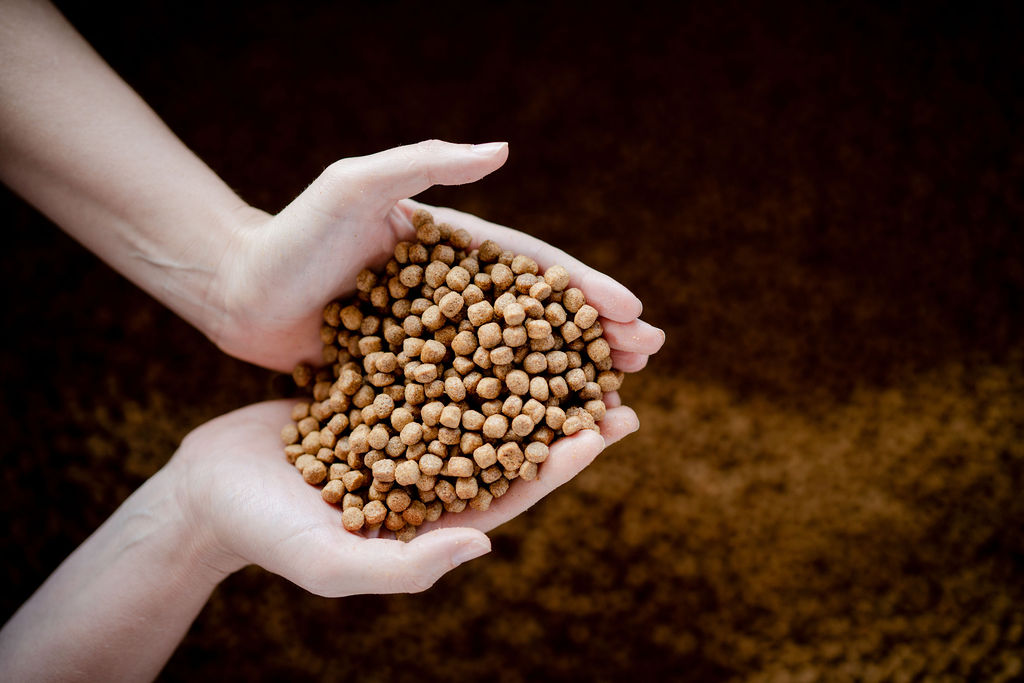
Feed represents 50% to 70% of the total cost of aquaculture production.4 In tilapia formulations alone, soybean meal can comprise 35% to 45% of the diet.5 When accounting for that share of cost and that share of the nutrient profile, feed stops being a line item and becomes a strategic lever – one that quietly shapes growth rates, survival percentages, feed conversion ratios (FCRs), environmental outputs and farm-level profitability.
That is why so much of USSEC’s engagement in the region is focused on the variables that determine feed performance: protein digestibility, amino acid profile consistency, ingredient reliability and the formulation know-how that ties them all together. When inputs are standardized, performance becomes predictable. And predictability is what export markets, certification bodies and investors are increasingly asking for.
When inputs are standardized, performance becomes predictable. Predictability is what export markets and investor confidence depend on.

Vietnam: A Sophisticated Market, a Long-Term Partnership
Vietnam remains one of the most sophisticated aquaculture exporters in the world. Its shrimp, tilapia and pangasius sectors are deeply integrated into international markets that demand certification, transparency and consistent performance, and our itinerary – which spanned feed mill teams at Viet Nhat, BioMar and FeedOne, alongside multispecies farm visits across the north and the Mekong Delta – reflected the full breadth of that value chain.
Viet Nhat Feed Mill in Hung Yen and Tilapia Farm in Hai Phong
At Viet Nhat’s feed mill, conversations with the chief executive officer and technical leadership traced a clear line from formulation philosophy to the fish in the pond. The team articulated why U.S. Soy stands apart as a protein source, how farmer expectations around feed performance have evolved and why high-quality feed is no longer just a nutritional question but a commercial one. The visit also marked an industry first: USSEC recognized Viet Nhat as one of the first feed mills anywhere to feature the Sustainable U.S. Soy label on its aquafeed products, a designation that requires at least 60% of the soy in the feed ration to be sustainably sourced from U.S. Soy verified through the U.S. Soy Sustainability Assurance Protocol (SSAP).6 A short drive away in Tan Ky, Hai Phong, the connected tilapia operation showed that thinking in practice. Farm managers spoke about the day-to-day importance of feed consistency for fish health and growth and about the role transparent, on-pack ingredient sourcing plays in their relationships with buyers.
BioMar Feed Mill in Vinh Long and the Mekong Delta Shrimp Sector
In the Mekong Delta, the BioMar shrimp feed mill offered a window into one of the most technically demanding corners of aquafeed. Shrimp nutrition is unforgiving. Small variations in digestibility or protein quality move FCRs in ways that show up immediately on a farmer’s bottom line. BioMar’s quality control team walked us through how they think about ingredient consistency, and the multigenerational shrimp farmers we met afterward made the connection viscerally clear. For them, feed is risk management before it is anything else.
Vinh Hoan Pangasius Operation in Dong Thap
Pangasius is uniquely Vietnamese, and Vinh Hoan’s integrated pangasius farm and processing capability in Dong Thap underscored why the Mekong Delta has become synonymous with this species. The conversations there centered on how feed quality affects fish performance in intensive pond environments, and on what “sustainability” looks like when a single farm sits at the intersection of an export-grade processing line and a global buyer base.
VINAFIS and the Vietnam Fisheries Society MOU
Across Vietnam, the institutional backdrop to these visits is USSEC’s three-year Memorandum of Understanding (MOU) with the Vietnam Fisheries Society (VINAFIS), signed in October 2025.7 The MOU is a structured commitment to elevating feed quality standards, supporting international certification pathways, strengthening technical training programs and expanding adoption of U.S. Soy ingredients across the sector.8 Time with the VINAFIS team reinforced something we believe deeply: sustainable aquaculture growth requires institutional alignment. Vietnam’s model demonstrates how collaborative frameworks can accelerate industry-wide improvement in ways that no single company or program could achieve alone.
Indonesia: Integration as a Sustainability Strategy
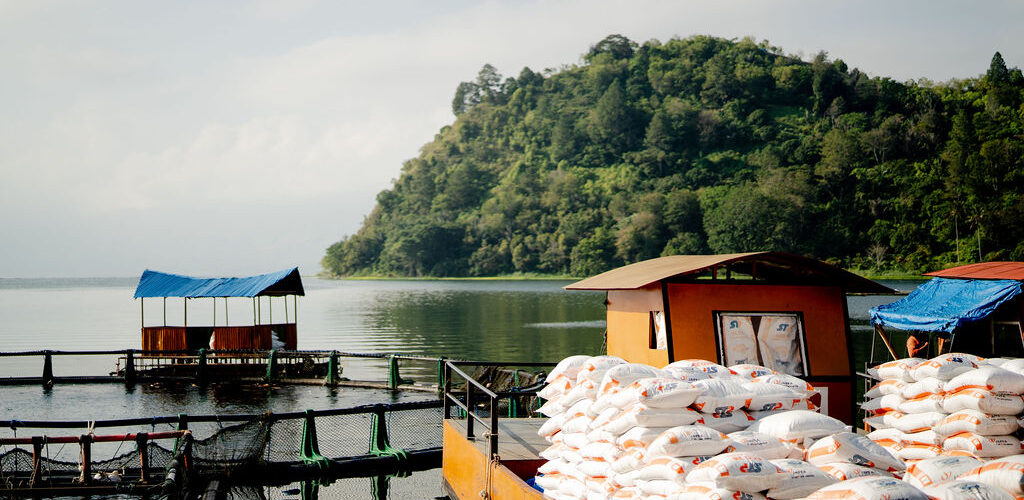
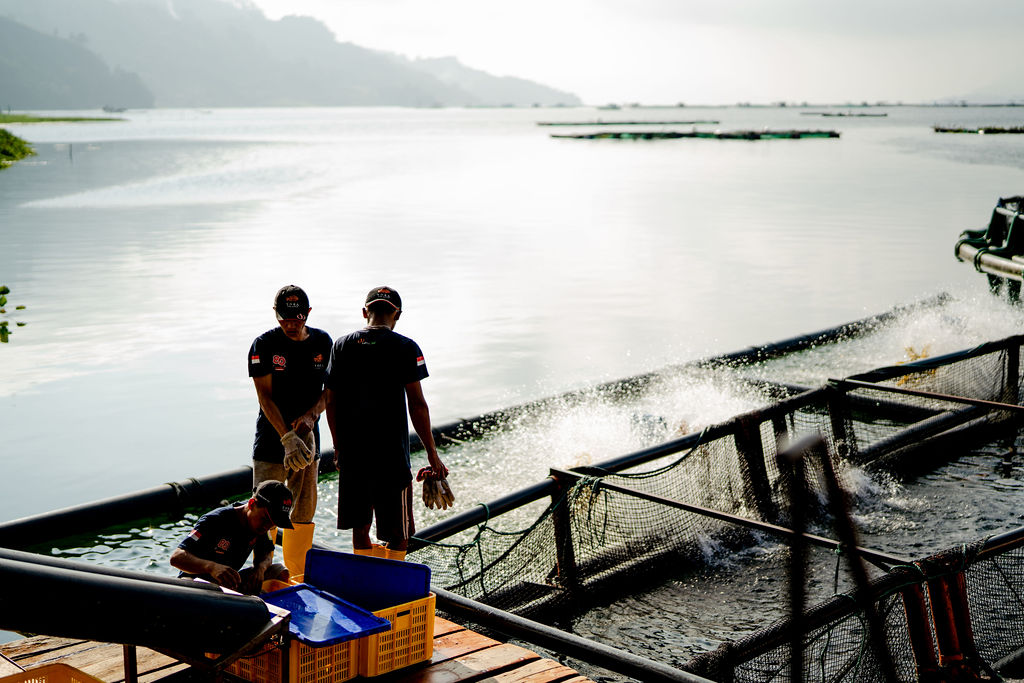
In Indonesia, the focus shifted from a multi-stakeholder value chain to a single, vertically integrated one. JAPFA, a leading, pan-Asian, industrial agri-food company manages a tilapia operation on Lake Toba in Sumatra that connects feed milling, fish health, cage farming and processing under one coordinated system,9 and a few hours with their team made the strategic logic of that model unmistakable.
Lake Toba itself is a remarkable production environment, and JAPFA’s director of fish health, farm manager and nutrition director each described the same idea from different angles: integration is what makes consistency possible at scale. When the people formulating feed are accountable to the people raising the fish, and the people raising the fish are accountable to the people processing them, biosecurity, quality control and sustainability outcomes all improve together. U.S. Soy enters that system as a high-performing, sustainable protein source that supports the entire chain rather than just one link in it.
Integration is what makes consistency possible at scale. Feed, fish health, farming and processing are not separate stories. They are one system.
Lake Toba is one Indonesia story, and an important one, but the country’s aquaculture footprint extends well beyond it. Earlier in 2025, USSEC partnered with the aquaculture technology company JALA on Shrimp Outlook 2025 in Yogyakarta, an event that convened roughly 350 shrimp farmers, exporters and technical experts to work through the operational and market challenges facing one of Indonesia’s most important export sectors.10 That kind of convening reflects the same logic we saw at Lake Toba: sustainable growth depends on connected systems and shared standards, not on individual operations doing well in isolation.
The Work Behind the Work: Capacity Building
Aquaculture growth is not just about tonnage. It is about people. Behind every successful shrimp pond in Vietnam, every tilapia cage in Indonesia and every feed mill we visited are farm managers, nutritionists, quality control technicians and feed buyers making daily decisions that determine performance and profitability. That is where the bulk of USSEC’s regional work actually happens.
Across Southeast Asia, our technical engagement is designed to give those professionals practical tools they can act on:
- Feed formulation workshops tailored to local species and production systems
- Quality extruded feed production training
- On-farm feed management training
- Performance benchmarking and cost optimization guidance
- Technical troubleshooting support and direct stakeholder dialogue
- Science-based decision tools, including digestibility databases and carbon footprint metrics
When a feed formulator better understands amino acid balance, or a farm manager understands how digestibility moves their FCR, the resulting decisions improve cost outcomes and environmental outcomes at the same time.11 Sustainable aquaculture growth begins with informed people making smarter feed choices, and capacity building is how that becomes a regional norm rather than an isolated success story.
U.S. Soy as Part of a Bigger Systems Story
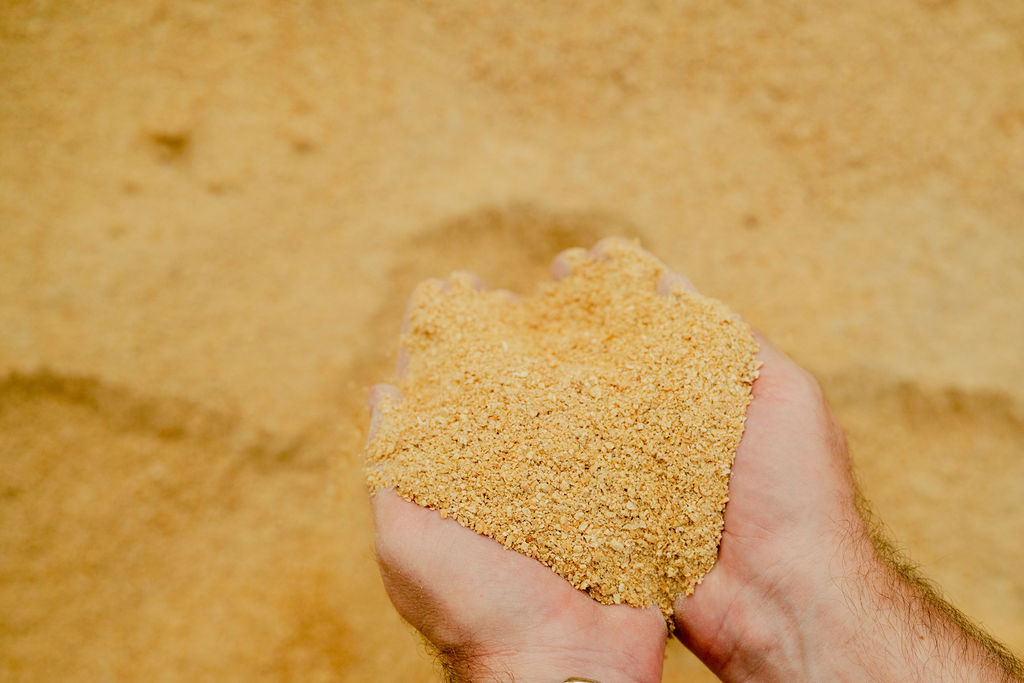
It would be easy to summarize this trip as an ingredient story. It is not. U.S. Soy is one part of a broader model built on stronger partnerships, better formulation, responsible sourcing and long-term sector development.12 What we saw in Hung Yen, Hai Phong, Vinh Long, Can Tho, Dong Thap and Lake Toba is what that model looks like in practice; producers and feed mills choosing high-quality, sustainable inputs because they translate into measurable improvements in FCRs, reduced nutrient waste and more predictable environmental outputs.
If global standards are tightening, the industry has to tighten its inputs. That is the case we make in every market we work in, and it is the case our partners in Southeast Asia are already proving on the ground.
Looking Ahead
Aquaculture is the fastest-growing food production sector in the world,13 and Southeast Asia will continue to be one of its most important engines. The question is not whether the region will scale, but how. Our answer, reinforced by every stop on this trip, is that resilient growth depends on stable inputs, measurable performance and collaborative frameworks that align feed mills, farmers, institutions and buyers around the same standards.
USSEC is grateful to the producers, feed mill teams and association partners who hosted us in January, and to the colleagues across our regional teams who made the visit possible. The work continues; in the next workshop, the next formulation review, the next farm visit and the next conversation about how to do more with less.
That is what soy-optimized, sustainable aquaculture looks like in motion. And it starts, as it always does, with feed.
1 The State of World Fisheries and Aquaculture 2024, Food and Agriculture Organization of the United Nations, 2024
2 Global tilapia production back on track after Covid-related slowdown, should surpass 7 million metric tons in 2025, Lola Navarro, SeafoodSource
3 Indonesia Positioned to Lead World Aquaculture Production in 2025, USSEC, 2015
4 FAO: Fish feed costs to remain high, Cliff White citing Food and Agriculture Organization of the United Nations, SeafoodSource, 2010
5 The Power of Feed Conversion Ratios in Aquaculture: Driving Profitability, Performance, and Sustainability, USSEC, 2025
6 USSEC Cooperates with Vietnamese Aquafeed Industry, Promotes Sustainable Aquaculture in Vietnam, USSEC, 2015; see also Sustainable U.S. Soy Label, USSEC
7 USSEC and VINAFIS join forces to advance sustainable aquaculture, Vietnam Investment Review, October 13, 2025
8 Strengthening Sustainable Aquaculture Partnerships in Vietnam, USSEC, 2025
9 Our Farming Practices, Toba Tilapia, PT Suri Tani Pemuka (a JAPFA company), June 2026
10 Shaping a Sustainable Future for Indonesia’s Shrimp Industry, USSEC, 2025
11 The Power of Feed Conversion Ratios in Aquaculture: Driving Profitability, Performance, and Sustainability, USSEC, 2025
12 U.S. Soy in Aquaculture, USSEC, 2025
13 The State of World Fisheries and Aquaculture 2024, Food and Agriculture Organization of the United Nations, 2024