Mastering the Handoff: Quality from Farm to Feed Mill

Think of a world-class relay race. Every runner must execute their leg flawlessly – but the race is won or lost in the handoff. One fumbled baton, and it’s over. Your poultry feed supply chain works the same way.
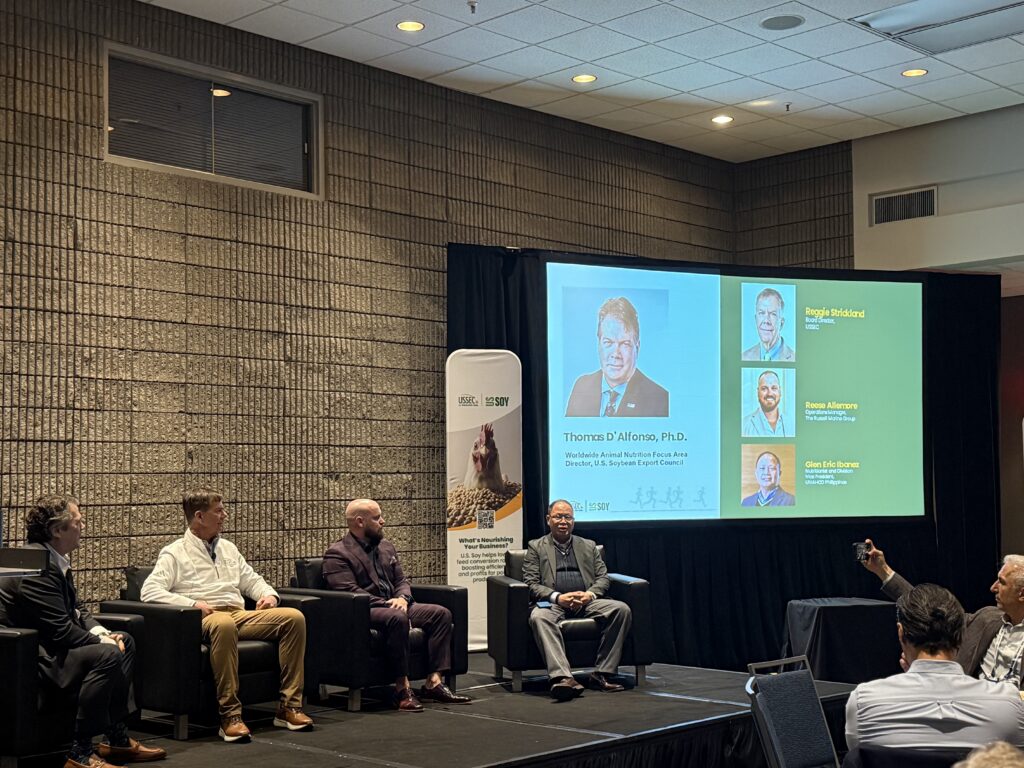
“If any player in the race drops that baton, quality is compromised for the animal eating it at the end of the supply chain,” says Thomas D’Alfonso, Ph.D., Worldwide Animal Nutrition Focus Area Director for the U.S. Soybean Export Council (USSEC) during a panel at the 2026 International Production & Processing Expo (IPPE), the world’s largest annual poultry, egg, meat, and animal food industry event.
Every player in your supply chain – from farmer to logistics partner to feed manufacturer – receives information, receives products, and passes them forward. The question is: are you capturing the maximum value at every stage?
Where Quality Begins: The U.S. Soy Farmer
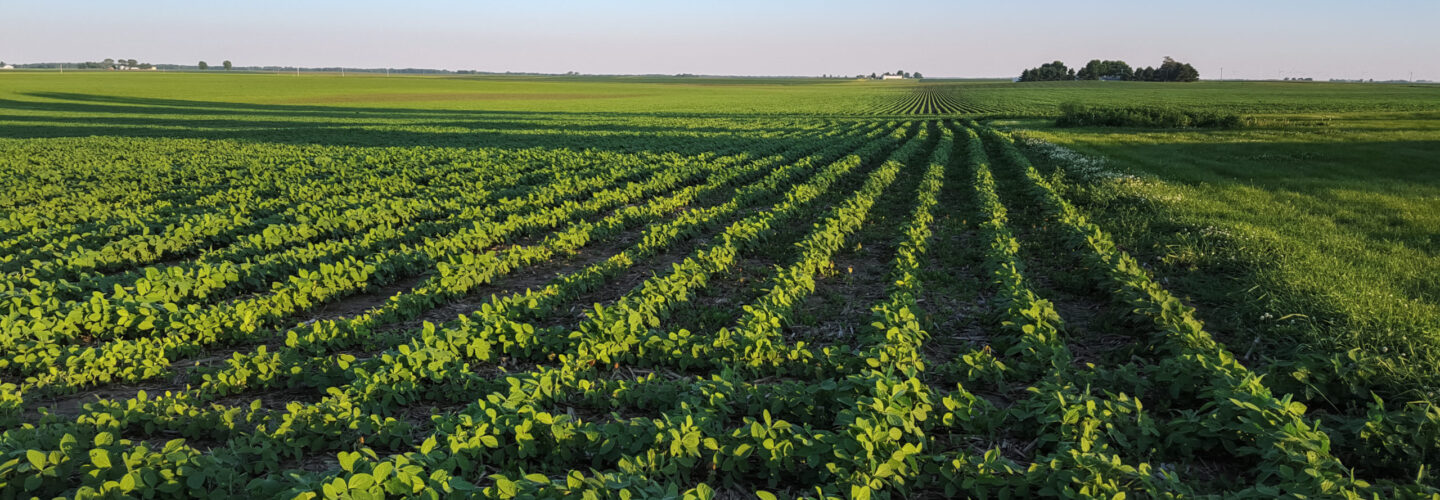
Quality starts in the soil. U.S. soybean farmers’ sustainable practices – precise nutrient application and responsible land stewardship – deliver the consistent, high-quality crop your operation depends on, with exceptional year-to-year reliability in nutrient composition and digestibility. 1
Reggie Strickland, a seventh-generation farmer from North Carolina and USSEC board member, explained how generational knowledge translates to quality: “We know the land almost as well or better than some of our family members. It is a part of our family because it’s been passed down for generations and we care for it.”
That intimate knowledge manifests in precision practices that directly impact what arrives at your feed mill. “We’re soil sampling. We’re doing things with the soil just so we can know what’s in the soil and what changes are coming from one year to the next,” Strickland noted. “We don’t make blanket applications just because we think this area of the farm needs some type of nutrient. We sample grids in two-and-a-half-acre samples. We’re even looking at going down to one-acre samples (for more precise applications).”
This precision agriculture approach, combined with the cooler, drier U.S. climate that allows natural dry down of the crop in the field, produces soybeans with significantly less heat damage than those produced in tropical climates requiring mechanical drying. Research shows soybean meal derived from U.S. Soy contains five times less total heat damage compared to meal from other major origins. 2
Learn more about Reggie’s farming practices here
Protecting Quality Through the Supply Chain
Once soybeans leave the farm, the race continues through an infrastructure network of roads, rivers, and railways. Here, third-party quality verification becomes critical.
Reese Allemore, Operations Manager at Russell Marine Group (RMG), a surveying and laboratory company in the U.S. export system, described their role: “We’re doing everything from tracking any type of barge locations up and down the river, really making sure that those barges or rail into the elevators is in a timely fashion landing at the same time as your vessels.”
RMG partners with Eurofins for advanced laboratory capabilities, enabling analysis that goes far beyond basic protein measurement. “It’s not just the protein that’s selling, it’s the more performance-based analysis,” Allemore explained. “We always promote the fact that we want you [exporters] to bring them [international customers] to the Gulf.
Allemore notes that RMG is focused on transparency. “Let [our customers] come to the office. Let us explain what the U.S. river system is about, what a barge is, what a ship is, and then let us walk the group through the laboratory, because at the end of the day, if they have that trust in U.S. Soy, it’s going to work for everybody.”
That laboratory work is central to proving the consistency that starts on U.S. farms. Through their Eurofins partnership, RMG provides certificates of analysis with each soybean meal shipment. They provide detailed nutritional profiles measured by near-infrared spectroscopy (NIRS) that go beyond standard grading to include amino acid composition and digestibility estimates. This means the quality data accompanies the product, giving nutritionists the confidence to formulate precisely rather than guess at what’s arriving at the port.
“That certainty matters because crude protein percentage tells only part of the story. What drives performance and profitability is how much of that protein birds can actually use. When feed formulation economics account for the digestibility advantage of soybean meal derived from U.S. Soy, the result is an estimated $20-$35 per metric ton3 premium over other origins.
Learn more about RMG’s testing protocols and why they matter here
The Finish Line: What Your Customers Expect
At the end of the supply chain sits the feed manufacturer and, ultimately, the producer who opens the bag. Glen Eric Ibanez, Nutritionist and Division Vice President at UNAHCO in the Philippines, shared what his retail feed customers demand: “They open the bag, take some product out, smell it, and look at it.” He knows his customers’ first impressions of his soybean meal matter.
For bagged feed manufacturers serving backyard and small-scale producers, consistency is everything. “There has to be that trust,” Ibanez emphasized. “They have to be able to trust the feed that they’re buying consistently.”
His company, celebrating 60 years in business, has also invested in near-infrared reflectance (NIR) capabilities to verify the consistency of incoming ingredients. When asked what he expects from suppliers, Ibanez was direct: “One thing that we really look for is consistency. When you say this is what you’re going to get from us and when we check it, that’s what we got. So far U.S. Soy has been very consistent; just from the lab analysis, the way that it’s sourced, the way it looks, and the protein digestibility.”
Learn more about the role of consistency in retail feed here
The Value You Can’t Improve After the Handoff
As a farmer, Strickland offered a critical insight that every international buyer should consider: “You cannot improve that product once it gets in that container or gets in that bag. If you’re buying a degraded product or a lesser product from the farm level, there’s no way you can improve it. I don’t care what you add to it.”
Soybean meal derived from U.S. Soy starts with a foundational advantage: lower moisture, minimal heat damage, and the consistent nutrient profile 2 that every runner in your supply chain works to protect.
What’s Nourishing Your Business?
From Strickland’s soil samples in North Carolina to Allemore’s certificates of analysis at the Gulf to Ibanez’s NIR verification in the Philippines, every handoff in the relay either preserves or diminishes the value of your feed ingredients. Soybean meal derived from U.S. Soy enters that relay with measurable advantages for lower damage, higher digestibility, and the consistency your operation can verify and trust. The operations that capture that full value are the ones that treat quality as a team effort and demand it at every stage.
Partially funded by the Soy Checkoff
[1] Oviedo-Rondón, E.O., Toscan, A., Fagundes, N.S., et al. (2024). Soybean meal nutrient composition, amino acid digestibility, and energy content according to the country of origin and year of harvest evaluated via NIRS. Journal of Applied Poultry Research, 33(3):100448.
[2] USA & Brazil Soybean Quality Dashboard, Data captured August 2025 https://trapast.shinyapps.io/13_soybean_quality/.
[3] Pope, M., B. Borg, R.D. Boyd, D. Holzgraefe, C. Rush, and M. Sifri. 2024. Quantifying the value of soybean meal in poultry and swine diets. Journal of Applied Poultry Research 33(2):100337. https://www.sciencedirect.com/science/article/pii/S1056617123000090?via%3Dihub