
Bright Ideas: Soybean Meal Trends Shaping Aqua and Livestock
Feed buyers across aquaculture, poultry, swine and ruminant markets are navigating the same challenges: volatile input costs, uncertain trade policy and growing scrutiny of what a protein source delivers.
Recently, discussions at USSEC’s annual Soy Connext event in Chicago pointed to several trends now reshaping how the global industry values soybean meal and why consistency and reliability are more important than ever.
Cost Pressure Is Pushing Formulations to the Edge
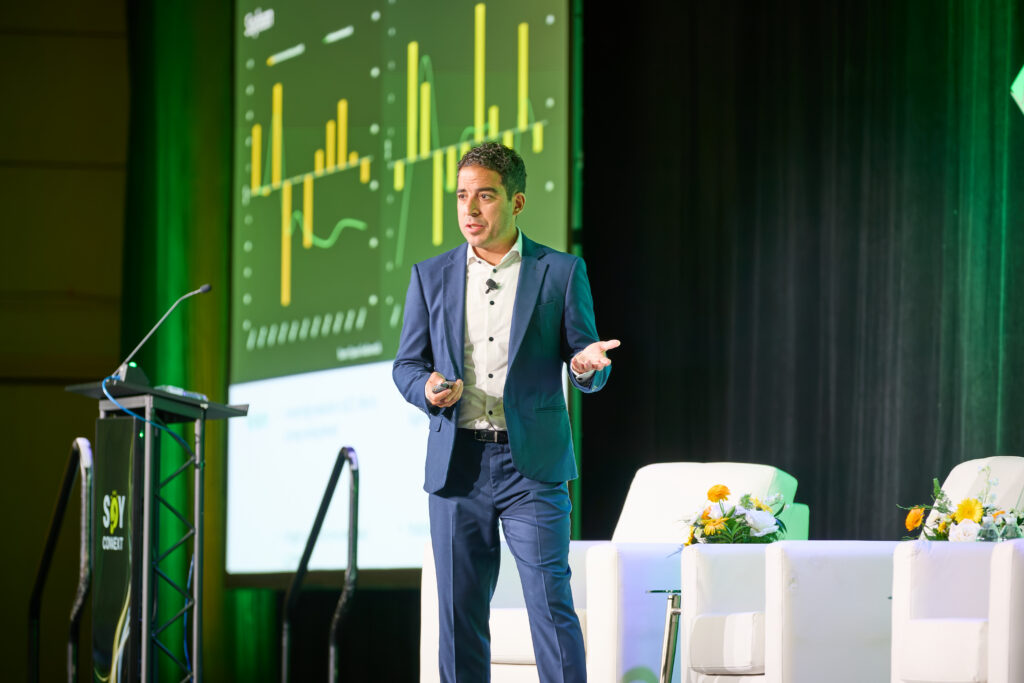
Across sectors, margins are thin, and every input is under review. Economist Angel Rubio of Expana described the past several years of feed and protein markets as “everything, everywhere, all at once.” He pointed to an unusual pileup of shocks that includes tariffs and shifting trade policy, conflict disrupting the Black Sea and Middle East, drought, a developing El Niño, avian influenza and the new world screwworm. Each one, he explained, ripples down the supply chain from farm to consumer, and they have arrived in rapid succession rather than one at a time. That market pressure lands squarely on the formulation bench.
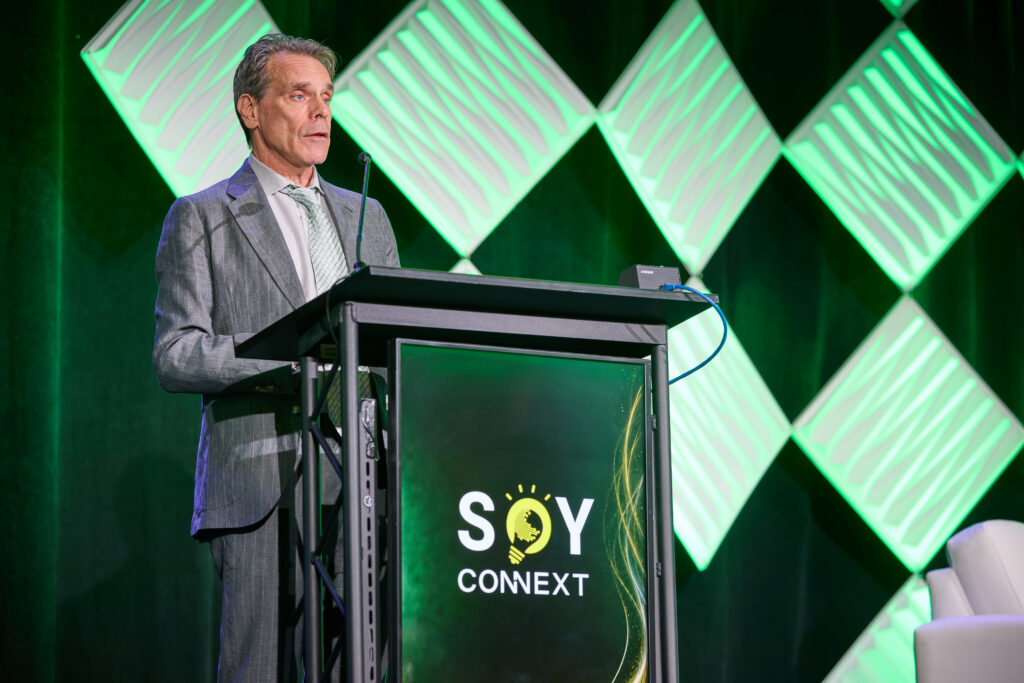
Building on Rubio’s outlook, Dr. Dominique Bureau of the University of Guelph and Wittaya Aqua noted that when costs climb, nutritionists often walk specifications back “as low as possible.” He noted it is precisely at those tight margins that differences between ingredients become most visible. A single inconsistent batch can undo the gains of a strong one, which is why Bureau favors reliability over the occasional high performer: “better average than good and bad.”
In shrimp feed, that consistency is enforced by biology. Eduardo Coronas Trinler, technical director at BioMar Ecuador, noted that the production cycle runs just 60 days, so “if you change the feed and you reduce the quality for one week, the producer will see it.” Short-term savings, he said, are “not a huge part of this industry.” The real question is, “How quick can we adjust the formulations to have the same animal performance?” Rejecting a bad lot is rarely the lever it appears to be, either. A single vessel can land 18,000 metric tons of soybean meal at an Ecuadorian mill, and if it deviates from quality once it has arrived, “then what do you do?”
Bureau made the same point from the nutritionist’s side: a cargo has usually travelled for weeks by the time it is tested and you “cannot turn the ship around,” so learning to characterize an off-spec ingredient and use it — knowing “what is acceptable, how far can you go” — is “the art of the matter.”
Substitution Is Accelerating, Especially in Aquaculture
Rising costs are also changing the ingredient mix. Coronas Trinler told the Soy Connext audience that the cost of key nutrients derived from fish meal and fish oil has climbed sharply and that future access to those nutrients is likely to be more limited. BioMar produces roughly 1.5 million metric tons of feed a year across 16 factories worldwide; the Ecuador operation accounts for close to 400,000 metric tons and is the group’s only plant specialized in shrimp feed, which makes it, in his words, “the biggest soybean meal consumer in the group.” Business there has been growing 50% year on year. Set against that growth, the arithmetic of scarcity is what concerns him: “We need to continue to grow as an industry, but the nutrients that are coming to this industry are more limited.”
The result, he said, is that “all ingredients are now being considered,” from protein concentrates to insect meal and algae oils. He called substitution “a great word for the change we will see” in feed, a trend that positions soybean meal as an increasingly important protein across both aquaculture and terrestrial livestock.
As soybean meal takes on a larger role in filling that gap, its reliability and feeding value become decisive, an area where soybean meal derived from soy grown in the U.S. offers buyers a dependable foundation. Those substitutions are already on the floor in Ecuador rather than on a roadmap: insect meal has been in the factory for a year, and protein concentrate was implemented within the past month. He was candid that soybean meal has its own ceiling in shrimp diets — “a limitation on some anti-nutritional factors” — but the direction of travel is clear enough that BioMar is designing its second Ecuador factory with the ingredient bins to match: “We will need more raw materials in the future. We will need substitution. We don’t know yet what, but we will definitely need more.”
Rubio, watching the same shift from the market side, described how the economics of fish meal alternatives have swung with fish meal prices: venture and private equity investment in insect meal ventures “looked horrible” a year ago when fish meal was cheaper, and the same investors are now revisiting them. Buying decisions also carry memory.
As Coronas Trinler put it, when fish meal prices ease, aquafeed producers will still be asking suppliers, “Why did you charge me five times more last year?”

Value Is Shifting from Crude Protein toward True Feeding Value
A recurring theme was that price and crude protein alone no longer tell the full story. Bureau argued that crude protein “is a shortcut and it doesn’t represent nutritive value,” and that origin-driven differences in handling and heat exposure can affect digestibility in ways a standard label will not reveal. In research he presented comparing origins in a tilapia trial, protein from U.S.-grown soybeans measured more digestible than the Brazilian lot, with feed efficiency following the same pattern. His guiding principle applies across species: “The best answer is given by the animal.”
Bureau’s wider point is one of resolution: it is “relatively easy to grossly estimate the chemical composition of” an ingredient and “a lot more difficult to go into the specific and what matters to the animal” — the difference that his tilapia work is designed to measure. Aquaculture has covered that ground quickly. Coronas Trinler said that five to 10 years ago shrimp feed was still formulated “to crude protein, crude nutrients, and it didn’t matter,” and that the move toward digestible nutrients reflects an adoption curve he called “impressively fast” — not only in feed mills but on farms, in how shrimp are fed and how ponds are aerated.
Technology Is Closing the Gap, but Reliability Remains the Hedge
Coronas Trinler said near-infrared analysis is already in daily use at his mill, and that calibrations for digestible nutrients would be “extremely beneficial” for purchasing decisions. Bureau pointed to complementary work on new analytical methods and on farm-level benchmarking that links the feed mill back to on-farm results. Until those tools mature, both emphasized the same practical safeguard: in the absence of a perfect test, a stable, dependable supplier is the best protection against costly variability.
For Bureau, the highest-value investment sits in the loop between the mill and the pond. Benchmarking across aquaculture farms shows wide variation in feed conversion, mortality and growth rate, and much of the remaining opportunity lies in on-farm management and disease control rather than in the formulation itself — which is why he would prioritize the feedback loop that connects ingredient, feed mill and farm, and then shows each producer how they are performing against regional peers. Technology is moving on the animal side too: BioMar owns a company building AI-driven feeding systems for shrimp, though Coronas Trinler cautioned that the industry “still need[s] to learn a lot more how to use it.”
Sustainability and Profitability Are Converging
Finally, sustainability is increasingly treated as a business fundamental rather than a separate goal. Coronas Trinler said the two are “not separated anymore,” noting that BioMar’s Ecuador operation sources its soybean meal entirely from the U.S. and citing a lower carbon footprint as a present-day competitive advantage. He described BioMar Ecuador as the only aquaculture feed mill buying 100% U.S. origin, and the commitment as non-negotiable internally. Now publicly traded, the company carries “clear goals on transparency, on reporting, on demonstrating what we say we do” — which, in his telling, makes a sustainability strategy that is 20 years old more important now than when it started.
Taken together, these trends reinforce a message that spans the aquaculture and livestock markets alike: the lowest-priced input does not always produce the lowest cost of animal protein. For buyers weighing digestibility, consistency, supply reliability and sustainability, USSEC makes the case for soybean meal derived from soybeans grown in the U.S. as a dependable foundation for efficient, high-performing feed.
Partially funded by USDA FAS