Bright Ideas: Soy Supply Chain Navigates Shifting Global Dynamics
Insights from Soy Connext 2026
One dominant theme that emerged from USSEC’s Soy Connext 2026 global conference focused on significant change and the industry’s response to it.
Both subtle and powerful changes across the global landscape are influencing the world’s soy supply chain. However, every link in that chain is adapting to ensure that soybeans, soybean meal and other soy products reach those who rely on these inputs.
Several industry experts shared their insights on forces influencing world trade, current soy market dynamics and corresponding adjustments during the event, held in early August in Chicago.
Notable Global Shifts
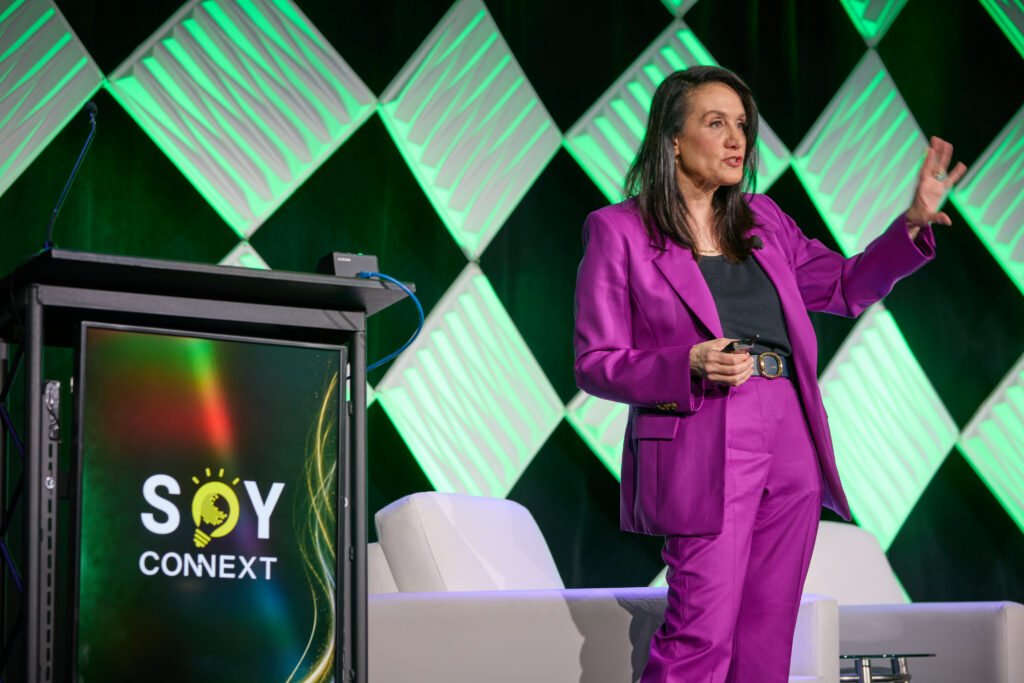
Many geopolitical factors influence trade, investment and agriculture. Soy Connext speaker Michelle Caruso-Cabrera, CNBC contributor, focused on two linked closely to global soy trade.
First, she discussed a shift in the U.S. approach to trade with China. Rather than encouraging adjustments in China’s economic approach, the U.S. is focused on managed trade, seeking a mutually beneficial balance in trade between these two large economies. Soybeans remain key to U.S. exports, along with other agricultural commodities. She also noted that how other markets around the world choose to approach trade with China will influence how global trade balances.
The second shift, Caruso-Cabrera explained, was the swing of the political pendulum across Latin America. In the past couple years, several new leaders in that region have focused on improving their countries’ economies and curbing crime, forming a new era of cooperation in the western hemisphere. As economies in Central and South America grow, so will their demand. At the same time, potential soybean and other agricultural commodity production could also grow.
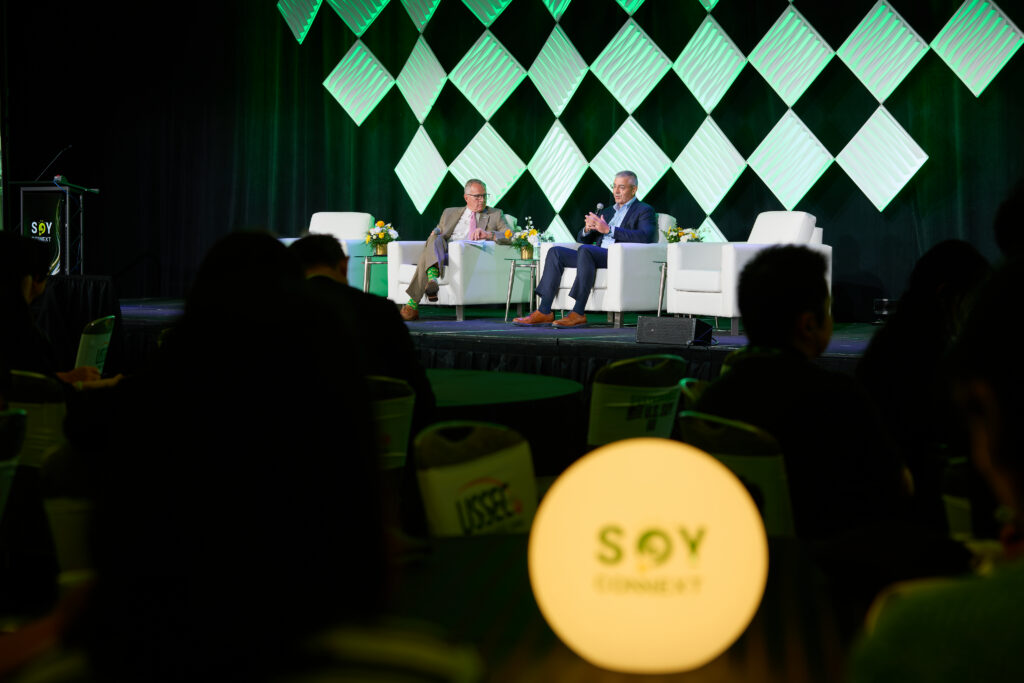
Greg Morris, ADM senior vice president and president of the company’s Agricultural Services and Oilseeds, reminded Soy Connext attendees of the impressive resilience of the industry during his fireside chat with USSEC CEO Jim Sutter. He noted the material disruptions the soy supply chain has navigated in the past several years, from the global COVID-19 pandemic and conflicts to weather-related challenges. He pointed out that cycles in agriculture are inevitable, but with a globally connected approach, they can be handled well, allowing the industry to emerge stronger. Throughout the past several years, it has.
Structural Soy Market Growth
Factors driving the growth in demand for soybeans, soybean meal and soybean oil go beyond these shifts. At Soy Connext, Tanner Ehmke, lead economist in the Knowledge Exchange Division at CoBank explained that as soybean production is increasing, world demand is increasing at roughly the same rate.
Ehmke credited biofuel policy in the U.S. and other regions around the world for causing soybean oil to trade more like an energy commodity. Those policies are encouraging a surge in soy crush around the world. During his conversation with Sutter, Morris confirmed that ADM is investing in measured crush facility expansions.
At the same time, Ehmke emphasized that protein demand – especially rising global poultry, pork and dairy consumption – support sustained soybean meal demand. He stressed the role of stable, reliable soy supply chains in getting soy products to users.
He described these soy market changes as structural, not temporary, and noted that more efficient U.S. soybean production is allowing both soy complex exports and crush to increase.
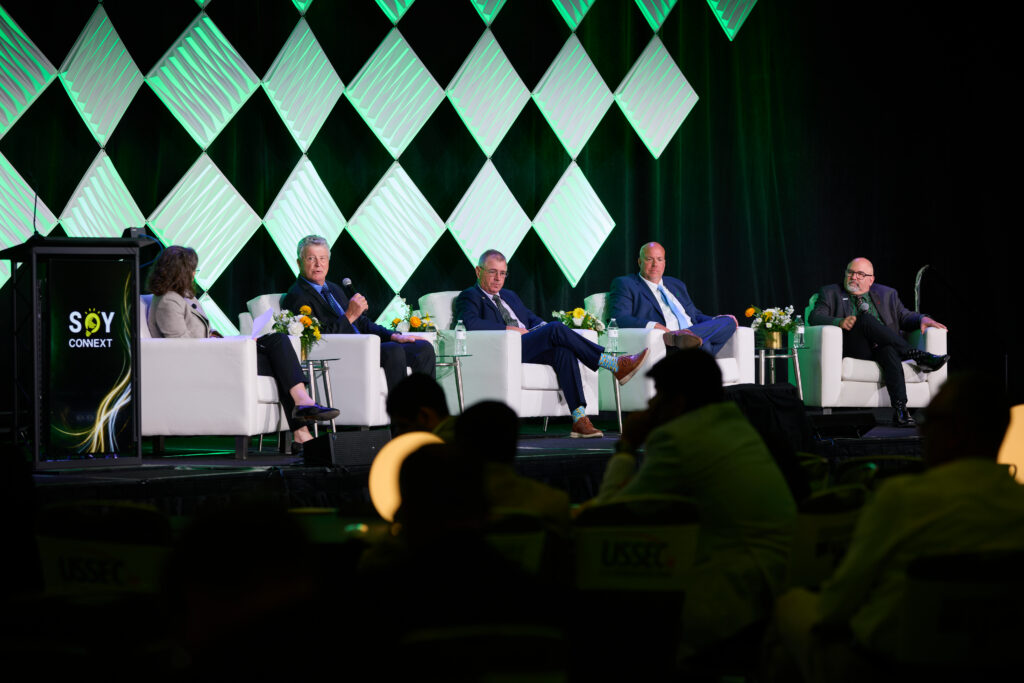
A panel of U.S. soybean farmers shared their ability to meet that demand as they provided real-time insight on the condition of the soybean crop in their regions. In many parts of the U.S., planting soybeans early coupled with timely rains through much of the growing season have farmers expecting average to above average yields. The below-average yields expected in pockets where planting was later or dry weather impacted crop growth could easily be offset by the overall increase in soybeans planted in 2026.
They also described the sustainability practices that improve their efficiency and resiliency, as they grow more with fewer inputs. Common practices include crop rotation, minimal soil disturbance and targeted, prescription application of inputs. Each farmer shared how they adapt these and other efforts to best fit their geography and farm operation.
Management of Resulting Risks
Significant changes inherently bring risks. For the soy supply chain to maintain its reliability, each link works to mitigate those risks.
The farmers shared how on-farm crop storage, crop insurance and various marketing strategies for selling their crops spread their risk. They acknowledged facing tight margins due to high input costs compared to crop prices. Though they worry about the factors they can’t control, they are excited about future opportunities, including those highlighted throughout Soy Connext.
Another speaker, John Ricci, managing director and global head of agricultural products for CME Group, echoed the incredible growth and transformative, constructive nature of the shifts observed in the soy complex. For example, energy companies now trade ag products. He said the average daily volume of soy complex trading is up 10% through July.
Ricci shared the trade and risk management tools available to help navigate the new normal. CME Group launched soybean oilshare futures and options in March 2025, allowing trade on the relative value of soybean oil to soybean meal. This and other innovative products help solve problems for the supply chain.
ADM’s Morris also emphasized the importance of connections, of consistently showing up and of considering how to ensure both higher highs and higher lows through agricultural market cycles – all as part of managing change. He said that ADM’s approach aims to be thoughtful, expanding to serve market needs while not allowing supply and demand to become too unbalanced.
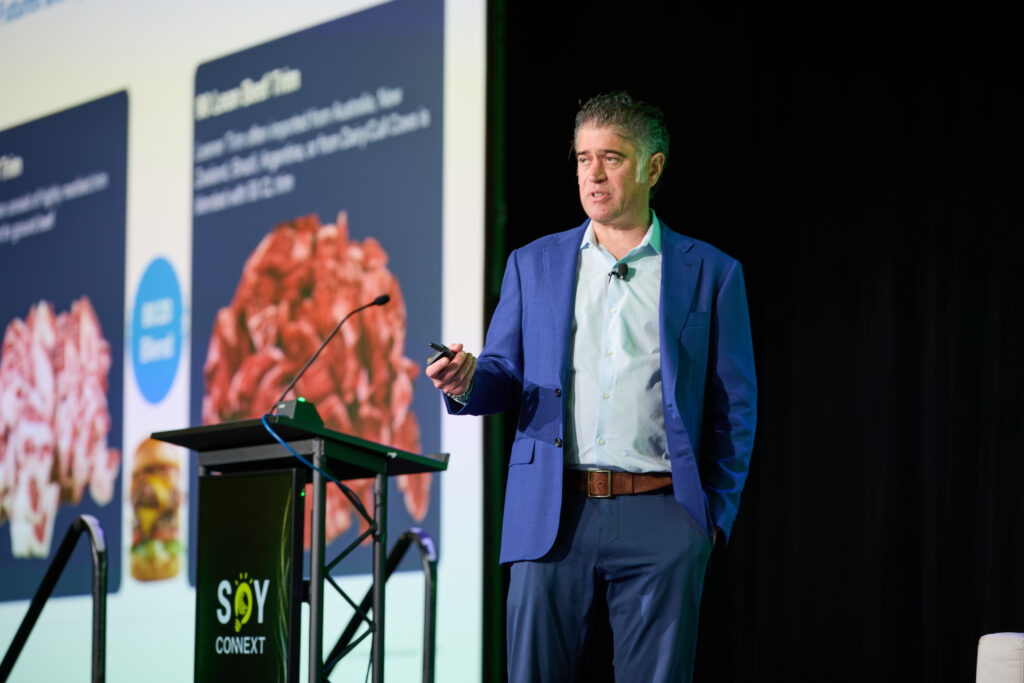
Soy Connext participants left Chicago with a deeper understanding of the current and future soy market. Despite very real risks and challenges, and the need for consistent industry collaboration, these industry experts shared their optimism for the future of the soy value chain and the role of the U.S. within it.
Partially funded by USDA FAS