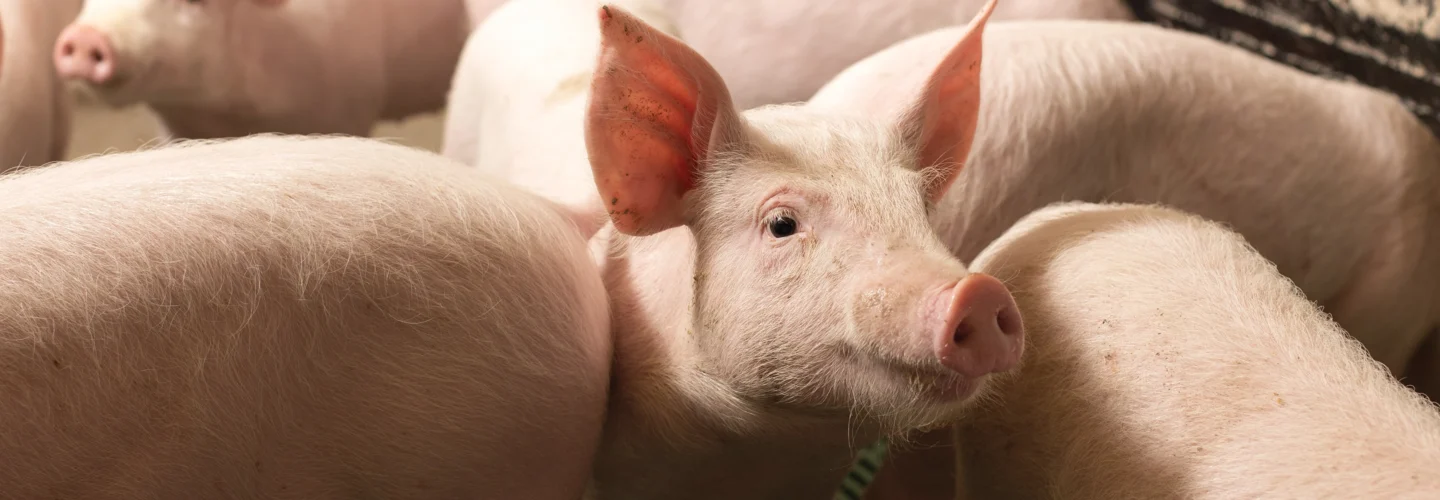
U.S. Soy in Swine Nutrition
Consistent Performance When Animals Need It Most
Heat stress creates costly challenges in swine operations, including reduced feed intake and lower growth rates, while driving up management costs.1,2
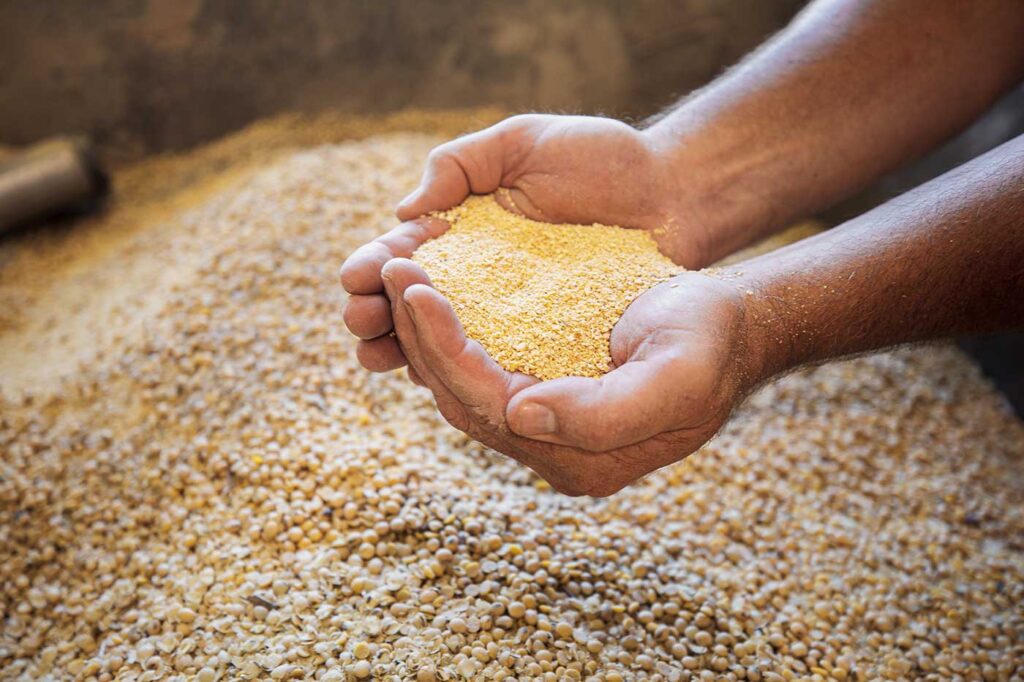
Soybean meal derived from U.S. Soy provides highly digestible amino acids, which support efficient growth and lean tissue deposition in a swine herd.3,4 U.S. Soy also delivers functional compounds, including isoflavones and immune modulators, that support digestive system development.5,6
Feed budgets work harder when nutrient digestibility is higher. Research shows that soybean meal derived from U.S. Soy delivers measurable feed value advantages in swine production, driven by superior nutrient digestibility and use.7,8
When diets are properly formulated around soybean meal derived from U.S. Soy, these nutritional and functional characteristics work together to support improved average daily gain, feed efficiency and overall wean-to-finish performance. Better digestibility means more usable nutrients reach the animal.
When accounting for what that nutrient density is worth at the formulation level, soybean meal derived from U.S. Soy represents at least $20 to $25 per metric ton9 in additional feed value, an advantage that compounds across every production cycle.
U.S. Soy represents at least $20 to $25 per metric ton9 in additional feed value
Uniformity That Reduces Operational Costs
The consistent nutritional bundle offered by U.S. Soy translates to numerous benefits in swine production:
- Consistent nutrient composition and digestibility support more predictable growth performance in swine by enabling precise diet formulation and reducing variability in nutrient supply.10,11
- Improved feed efficiency ratios lower the per-pound cost of production through the delivery of highly digestible amino acids and energy.10
- Strengthened immune response lays the groundwork for a healthy, high-performing herd, especially critical during respiratory or environmental challenges.12,13
- Superior nutrient use comes from the high digestibility of soybean meal protein and relatively low levels of anti-nutritional factors when properly processed.4
- Exceptional amino acid balance supports lean tissue development and efficient protein deposition in growing pigs.4,14
- Predictable protein levels and amino acid digestibility enable precise diet formulation with lower safety margins.15
U.S. farmers’ precise nutrient application and responsible land stewardship deliver a consistent, high-quality crop with exceptional year-to-year reliability in nutrient composition and digestibility.5
That consistency allows nutritionists to formulate rations with greater precision, reducing unnecessary safety margins, minimizing dependence on costly synthetic amino acids and additives, and improving return on investment for swine producers.
Foundation for Optimal Early Development
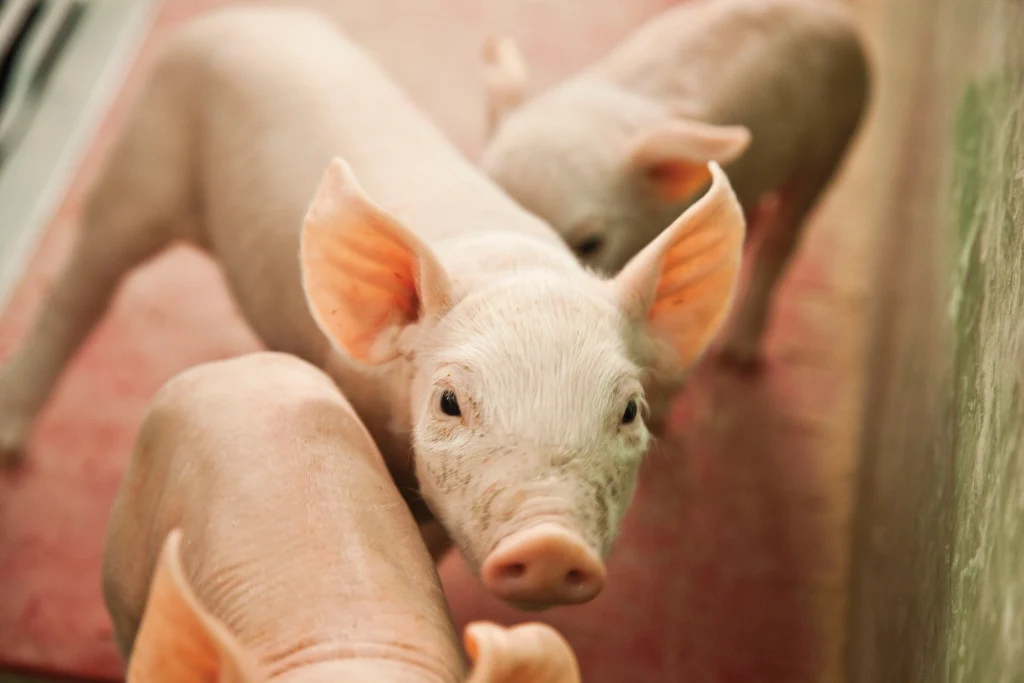
High-quality U.S. Soy used in post-weaning diets can reduce the need for expensive specialty additives, while supporting proper digestive system development in young pigs. Establishing this strong nutritional foundation early in life helps support optimal growth performance and feed efficiency throughout their lifetime, from the nursery phase through market weight.
U.S. Soy is a Sustainable Source of Protein and Energy
U.S. Soy is largely grown by family farms that demonstrate care for the earth and its resources. Backed by the U.S. Soy Sustainability Assurance Protocol, soybeans grown in the U.S. are responsible for fewer greenhouse gas (GHG) emissions and have less environmental impact from factors such as deforestation and soil erosion.16
U.S. Soy provides documented environmental advantages for operations serving sustainability-focused markets without compromising the performance and profitability businesses require.
U.S. Soy Nourishes Your Business
Consistent quality enables precision formulation, supports animal performance during stress and delivers measurable ROI for operations focused on long-term profitability.
Additional Resources
- A meta-analysis of the effects of high ambient temperature on growth performance of growing-finishing pigs, D. Renaudeau, J. L. Gourdine and N. R. St-Pierre, Journal of Animal Science, 89(7),2220–2230, 2011
- Factors influencing the structure and function of the small intestine in the weaned pig: A review, J. R. Pluske, D. J. Hampson and I. H. Williams, Livestock Production Science, 51(1–3), 215–236, 1997
- Nutritional properties and feeding values of soybeans and their co-products, H. H. Stein, L. L. Berger, J. K. Drackley, G. C. Fahey, D. C. Hernot and C. M. Parsons, In Soybeans: Chemistry, Production, Processing, and Utilization, pp. 613–660, 2008
- Chemical composition and amino acid digestibility of soybean meal produced in different countries, L. V. Lagos and H. H. Stein, Journal of Animal Science, 95(4), 1626–1636, 2017
- Effects of soybean isoflavones on the growth performance, intestinal morphology and antioxidative properties in pigs, Y. P. Li, X. R. Jiang, Z. X. Wei, L. Cai, J. D. Yin and X. L. Li, Animal, 14, 2020
- Immunomodulatory potential of dietary soybean-derived isoflavones and saponins in pigs, B. N. Smith and R. N. Dilger, Journal of Animal Science, 96(4), 1288–1304, 2018
- Economic value and environmental impact of soybean meal in poultry and swine diets, M. Pope, R. D. Boyd, D. Holzgraefe, H. Monaco, and M. Sifri, Journal of Applied Poultry Research, 33, 100449, 2024
- Toward precise nutrient value of feed in growing pigs: Effect of meal size, frequency and dietary fibre on nutrient utilisation, É. Chassé, F. Guay, K. E. Bach Knudsen, R. T. Zijlstra and M. P. Létourneau-Montminy, Animals, 11(9), 2598, 2021
- Quantifying the value of soybean meal in poultry and swine diets, M. Pope, B. Borg, R. D. Boyd, D. Holzgraefe, C. Rush and M. Sifri, Journal of Applied Poultry Research 33(2):100337, 2024
- Nutritional value of feed ingredients of plant origin fed to pigs, H. H. Stein, L. V. Lagos and G. A. Casas, Animal Feed Science and Technology, 218: 33–69, 2016
- Nutrient Requirements of Swine (11th rev. ed.), National Research Council (NRC), National Academies Press, 2012
- Effects of dietary soy isoflavones and soy protein source on response of weanling pigs to porcine reproductive and respiratory syndrome virus infection, B. N. Smith, A. Morris, M. L. Oelschlager, J. Connor and R. N. Dilger, Journal of Animal Science, 97(7): 2989–3006, 2019
- Effects of dietary soybean meal concentration on growth performance and immune response of pigs infected with porcine reproductive and respiratory syndrome virus, S. J. Rochell, L. S. Alexander, G. C. Rocha, W. G. Van Alstine, R. D. Boyd, J. E. Pettigrew and R. N. Dilger,Journal of Animal Science, 93(6): 2987–2997, 2015
- The optimum dietary amino acid pattern for growing pigs, T. C. Wang and M. F. Fuller,British Journal of Nutrition, 62(1), 77–89, 1989
- Prediction of the concentration of standardized ileal digestible amino acids and safety margins among sources of distillers dried grains with solubles for growing pigs: A meta-analysis approach, Z. K. Zeng, G. C. Shurson and P. E. Urriola,Animal Feed Science and Technology, 231, 150–159, 2017 16 Agri-footprint™ 6.3 Life Cycle Inventory Database, Mérieux NutriSciences | Blonk, U.S. Soybean Export Council, 2025; Environmental Outcomes from On-Farm Agricultural Production in the United States (Fourth Edition), Field to Market: The Alliance for Sustainable Agriculture, ISBN: 978-0-578-33372-4, 2021; 2017 National Resources Inventory Summary Report, USDA Natural Resources Conservation Service, 2017
- Agri-footprint™ 6.3 Life Cycle Inventory Database, Mérieux NutriSciences | Blonk, U.S. Soybean Export Council, 2025; Environmental Outcomes from On-Farm Agricultural Production in the United States (Fourth Edition), Field to Market: The Alliance for Sustainable Agriculture, ISBN: 978-0-578-33372-4, 2021; 2017 National Resources Inventory Summary Report, USDA Natural Resources Conservation Service, 2017