Women in Aquaculture: Powering a More Sustainable Global Industry
Aquaculture now provides more than half of the world’s seafood for human consumption, making it one of the most critical food production sectors on the planet.1 As demand for high-quality, responsibly produced protein continues to rise, the industry’s rapid growth is being powered not just by technological innovation, but by people – the farmers, researchers and leaders who drive the global seafood system forward.
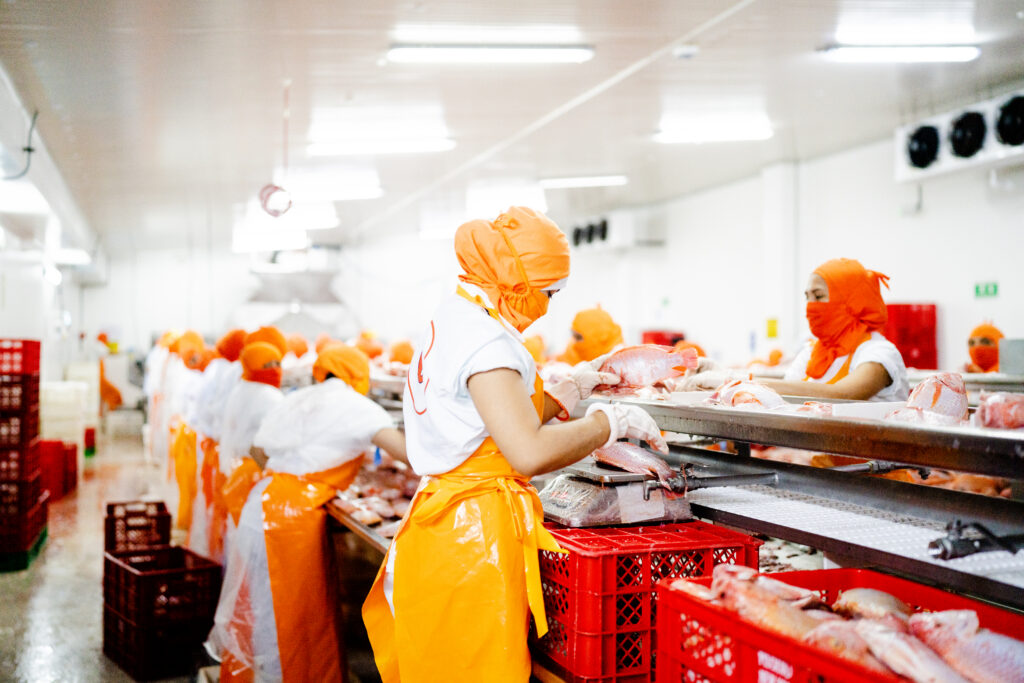
Globally, the fisheries and aquaculture sector employs an estimated 62 million people in primary production alone. Women represent roughly half of the workforce across fisheries and aquaculture value chains, contributing at every stage from production and feed management to processing, research and trade.2
But the role of women in aquaculture starts long before a fish ever hits the plate. It starts in the fields, where U.S. soybean farmers produce a key ingredient used in aquaculture feeds around the world, and continues across the aquaculture value chain, where farmers, feed professionals, processors and researchers turn those ingredients into nutritious fish protein.
As Janna Fritz, former chair of the U.S. Soybean Export Council (USSEC), said in her opening remarks at Soy Connext last year:
“Women are responsible for roughly half of the world’s food production. Globally, women are leading farms, driving research and serving on boards that steer the future of agriculture. I’ve had amazing opportunities to travel the world and see first-hand how vital women are to global agriculture.
When we elevate women’s voices, we strengthen the future of farming and global food security. This is another way U.S. Soy is leading—by championing inclusion. I encourage you to learn about the contributions of women in agriculture in your region and support their expertise and leadership.”
That same principle holds true across aquaculture. Women are essential to building a more sustainable, resilient and productive global seafood industry — and to strengthening the connection between sustainable agriculture and sustainable aquaculture.
This Women’s History Month, USSEC recognizes and celebrates the indispensable role women play in advancing a more sustainable and resilient global aquaculture industry – a growing market for soy.
Women Across the Global Aquaculture Value Chain
From Latin America to Africa, from Southeast Asia to Europe and North America, women play essential roles throughout the aquaculture value chain.
They are:
- Farm managers and hatchery technicians who oversee day-to-day operations, manage water quality and ensure fish health.
- Feed mill operators and nutrition specialists who optimize feed efficiency and monitor ingredient quality to reduce environmental impact.
- Quality assurance leaders and processing experts who maintain food safety standards and ensure consistent product quality for global markets.
- Researchers and academics who advance knowledge in breeding, disease prevention and sustainable farming practices.
- Exporters, marketers and entrepreneurs who connect producers with new markets and drive business growth.
- Community leaders who leverage aquaculture to enhance local food security, nutrition and economic opportunity.
In many regions, women are central to day-to-day farm operations and financial management. In others, they are leading innovation in fish health, sustainability and responsible sourcing of feed ingredients, including soy.
Their contributions are part of a larger global food system story. Women help drive agricultural production, ingredient development, feed formulation and aquaculture performance. From the women helping grow U.S. soy to the women managing feed, farming fish and shaping seafood markets, their work supports a more connected and sustainable protein system.
“Women are essential at every stage of the aquaculture value chain, including the agricultural systems that supply high-quality feed ingredients like U.S. Soy. Recognizing that connection helps us better understand how inclusion, sustainability and food security are all linked,” said Morgan Cheatham, Director of Aquaculture at the U.S. Soybean Export Council.
Yet despite this contribution, women often face barriers to accessing capital, advanced technical training, leadership roles and decision-making authority.2
Unlocking that potential is the only way to secure a sustainable aquaculture future.
Inclusion Is a Performance Strategy
When women have equal access to education, technical knowledge and leadership opportunities, operations improve.
Studies across sectors consistently show that diverse leadership teams deliver stronger financial outcomes and better risk management. In aquaculture, that can translate to:
- More efficient feed use.
- Improved animal health practices.
- Stronger environmental compliance.
- More resilient supply chains.
Inclusion drives performance. Performance drives sustainability. Sustainability drives long-term growth.
Leadership in the Next Era of Aquaculture
The future of aquaculture will be shaped by climate adaptation, evolving consumer expectations, digital innovation and sustainability transparency. Women are increasingly stepping into leadership roles that influence these priorities – from executive positions in feed companies to research leadership in aquaculture science or senior associates at seafood-focused investment funds.
Their voices matter in discussions about sustainable ingredient sourcing, including the use of high-quality soy in responsibly formulated feeds. Women’s leadership strengthens collaboration across the value chain, ensuring that production decisions balance profitability, environmental responsibility and social impact.3 A modern aquaculture industry must reflect the diversity of the communities it serves and the global markets it feeds.
Building a Stronger Global Industry
Supporting women in aquaculture is not tangential. It is central to building a resilient, high-performing global seafood system.
Through technical programming, knowledge exchange and global partnerships, USSEC contributes to an ecosystem where innovation and inclusion go hand in hand.
As aquaculture continues to expand to meet the protein needs of a growing population, the industry’s long-term success will depend on investing in talent, strengthening expertise and removing barriers to participation.
The future of aquaculture will not be built by technology alone.
It will be built by people – and women are essential to that foundation.
Partially funded by the Soy Checkoff
[1] The State of World Fisheries and Aquaculture 2024, Food and Agriculture Organization of the United Nations, 2024
[2] Gender in fisheries and aquaculture, Food and Agriculture Organization of the United Nations, 2024
[3] Diversity matters even more: The case for holistic impact, McKinsey & Company, December 2023