The ROI of IPRS: More Growth, Less Waste
In aquaculture, technology alone doesn’t guarantee better outcomes. It’s how that technology is managed and how it integrates into existing farming systems that ultimately determines its value.
The In-Pond Raceway System (IPRS) is a perfect example of this. Gaining popularity as one of the most efficient fish farming technologies available today, IPRS allows aquafarmers to raise more fish with reduced environmental impact.1 However, its efficiency doesn’t come only from the system itself – it also depends on how well it is managed. And specifically, how farmers manage one key input: feed.
When IPRS is managed well and combined with high-quality inputs, the payoff can be impressive: improved feed efficiency, reduced costs, healthier fish and more predictable harvests.1 That’s the beauty of IPRS: it doesn’t just improve operations; it impacts the economic bottom line in pond-based aquaculture operations.
Let’s take a closer look at what IPRS can do when managed correctly.
What Makes IPRS Economically Attractive?
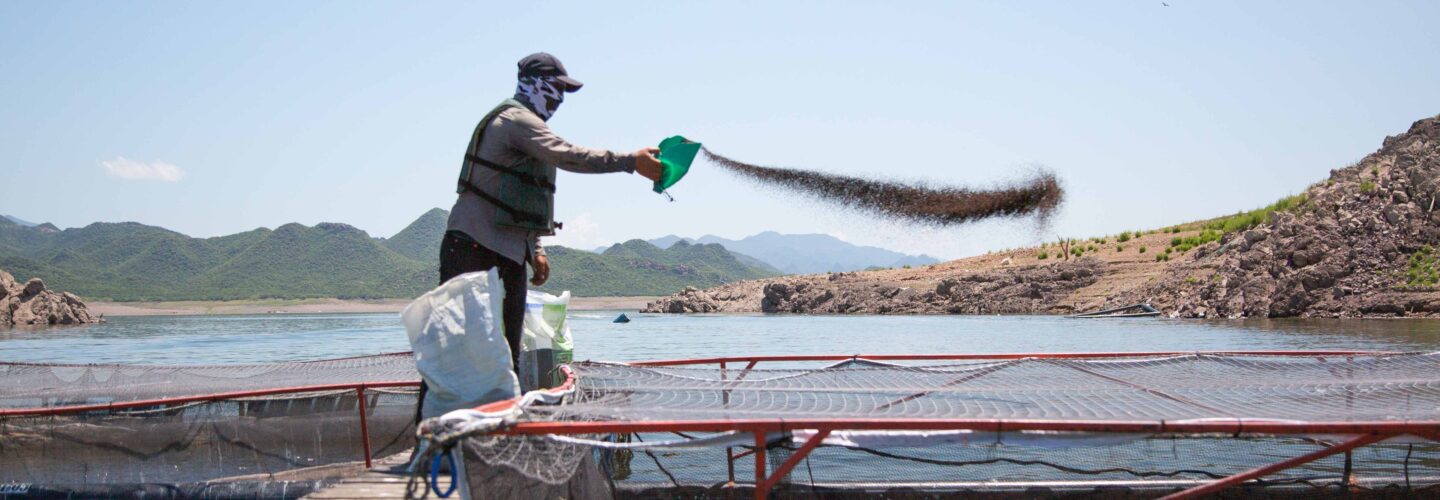
At its core, IPRS is a system built around precision and efficiency. Instead of having fish swim freely in the open pond, IPRS confines fish to walled raceways, or cells, within the pond. These raceways provide continuous water flow, optimized aeration, centralized feeding and ideally, effective sludge removal.
This structure allows farms to:
● Increase fish stocking density without sacrificing water quality1
● Improve oxygen levels and reduce stress-related mortality1
● Monitor biomass and feeding with greater accuracy1
● Simplify harvest and feeding operations1
● Enhance fish health and welfare through improved water quality and observation, as well as reduced disease or parasite issues1
But beyond operational advantages, IPRS also changes cost-structures and profitability on aquaculture farms.
Cost Trade-Offs: Upfront Investment for Long-Term Gains
Implementing an IPRS system requires capital. Infrastructure investments include raceways, aeration equipment, blowers, backup generators and sludge management mechanisms. According to analysis by Fantini Hoag,2 initial construction costs for a 63-cubic-meter IPRS cell in a 0.4-hectare pond are $34,570, with construction of the raceway accounting for $25,000, or 72%, of the total amount. This is equivalent to $396 per cubic meter of raceway volume.
For farmers used to conventional ponds, this level of initial capital outlay is often a deterrent to adoption. But this is not just an investment in new equipment – it’s a means of producing long-term cost savings and more stable performance. When operated correctly, IPRS systems are not only more productive but significantly more cost-effective per unit of output.1
Let’s break down how.
Key Benefits of Well-Managed IPRS Systems
1. Lower Feed Costs Through Better Feed Efficiency
Feed is typically the largest line item in aquaculture budgets. That’s why feed efficiency matters. In IPRS, feed delivery can be closely correlated with biomass and growth data. That level of control can lead to feed conversion ratio (FCR) improvements of 10–25%,1 leading to meaningful reductions in cost per kilogram of fish produced. Over time, that efficiency adds up, especially at scale.
2. More Productive Labor
While IPRS demands skilled workers, its centralized structure simplifies many labor-intensive tasks. Feeding, cleaning and harvesting become less time-consuming and more standardized.1 The result? Fewer labor hours per ton of fish, with less day-to-day variability.
3. Reduced Health Risks and Harvest Loss
Consistent water flow and oxygenation or aeration, combined with better fish monitoring, leads to healthier fish populations. Farmers anecdotally see fewer disease outbreaks and reduced need for pharmaceutical treatments.1 Consistent growth rate within a fish population also means fewer fish outside of optimum size range at harvest, resulting in reduced harvest losses and increased processing efficiency.1
4. Faster Turnover and Predictable Outcomes
With improved growth rates and better environmental control, IPRS systems allow for more frequent harvest cycles and tighter inventory control.1 This predictability helps producers better plan cash flows and more effectively respond to changes in market demand.1
The System Alone Isn’t Enough
While IPRS creates conditions for success, it doesn’t guarantee it. Success in IPRS depends on another critical input: feed.
IPRS is a high-performance environment, and it requires high-performance nutrition. Feed that is of inconsistent quality, low in digestibility or poorly matched to system needs, can compromise everything, from oxygen levels to efficient waste collection and, ultimately, FCR.1
This is where U.S. Soy-optimized aquafeed can help.
How U.S. Soy Enhances IPRS Performance
IPRS is designed to minimize waste and maximize growth, but only if the feed matches the system. U.S. Soy-optimized feeds bring several performance-enhancing benefits that support IPRS goals:
Consistency Matters
In IPRS, biomass is high, and growth is critical to success. Variability in feed performance can create bottlenecks and inefficiencies. Feed performance starts with physical and nutritional feed quality, and feed quality is driven by feed ingredient quality. U.S. Soy is of highly consistent quality due to best management practices used on U.S. farms and strong post-harvest infrastructure systems.3 Subsequently, feeds formulated with U.S. Soy are nutritionally uniform and provide more consistent nutrition to fish. This stability is essential for planning feed inputs and anticipating animal performance.
Digestibility Drives Efficiency
U.S. Soy is protein rich and the amino acids which make up this protein are highly digestible, which means more of the feed protein is absorbed by the fish and less is wasted. When highly digestible feeds are efficiently fed to fish, waste outputs are reduced, which benefits high-density systems like IPRS.1
Supports Oxygen Balance
Poor-quality feeds that are uneaten or not well digested increase oxygen demand and the waste produced consumes oxygen as it breaks down in the water.1 By using high-quality soy-based feeds and diligent feed management, farms can more easily manage dissolved oxygen concentration and maintain a more stable culture environment.1
Feed and System Must Be Aligned
Both the 2022 USSEC IPRS Manual and the 2024 IPRS Technical Bulletin emphasize the following: IPRS is a feed-forward system. That means feed inputs directly determine how well the system performs. Poor-quality feed limits the value of the technology. High-quality feed unlocks its full benefits.
When farms overlook this relationship, they often struggle to produce consistently high yields and recover their initial investment. But when feed, management and production system are aligned, the results speak for themselves: better fish performance, fewer environmental impacts and improved bottom-line performance.
Scaling Sustainably with IPRS
Today’s aquaculture producers are expected to do more with less. They’re managing rising demand, stricter sustainability requirements and volatile market conditions, all while trying to keep production costs in check.
IPRS, paired with high-quality feed, offers an opportunity for sustainable growth. It’s not just about producing more fish. It’s about producing smarter, using better feed, cleaner water and less labor to achieve better results.
That’s the kind of sustainable innovation the industry needs.
Smart Systems, Smart Inputs, Better Outcomes
IPRS isn’t a shortcut to success. It’s a tool, and like any tool, its value depends on how it’s used.
With the right management and the right feed, IPRS transforms aquaculture from a reactive process into a proactive system. Producers gain more control over inputs, more confidence in outputs and more consistency in results.
U.S. Soy plays a central role in this equation. By delivering reliable, digestible and environmentally responsible protein, U.S. Soy allows IPRS systems to perform at their best, sustainably and profitably.
Together, technologies like IPRS represent a new standard for what’s possible in fish farming: precision systems backed by quality nutrition, operated by teams that understand how to drive sustainable improvement.
That’s not just progress – it’s aquaculture done right.
This article is funded in part by the Soy Checkoff.
1 The In-Pond Raceway Systems, USSEC, 2022
2 Bioeconomic Analysis of Catfish Produced in In-Pond Raceway Systems, Leticia Fantini Hoag, 2021
3 Amino acid digestibility in soybean meal produced in the United States, Brazil, Argentina, India, or China, Hans H. Stein, 2021